
What MVP feature prioritization taught us about product clarity, user interviews, and early-stage startup growth
When we started building our startup MVP, I was convinced we were on the right path.
Users were talking.
Feedback was coming in.
Feature requests were constant.
So naturally, we assumed the solution was simple: build more.
We kept adding features, believing that better MVP feature prioritization meant delivering everything users asked for. From the outside, it looked like progress. From the inside, growth felt slow, confusing, and unpredictable.
That’s when it became clear:
The problem wasn’t execution. It was poor MVP feature prioritization.
The Early Assumption That Broke Our MVP Feature Prioritization
Our biggest assumption was straightforward:
If users ask for features, building them must create value.
This is one of the most common MVP development mistakes founders make.
We treated feature requests as instructions instead of signals. Each request felt urgent. Each addition felt necessary. But over time, our startup MVP became harder to explain, harder to use, and harder to improve.
Instead of creating momentum, we created noise.
Why MVP Feature Prioritization Fails Without Product Clarity
Feature prioritization without clarity is just guesswork.
We didn’t have a clear answer to:
- Who the product was really for
- What single problem it solved
- What result the user actually wanted
Without product clarity, every feature felt equally important. And when everything is important, nothing truly is.
This lack of clarity made decision-making slow and reactive — a silent killer for early-stage startups.
What User Interviews for Startups Taught Us About Features
Everything changed when we improved how we ran user interviews for startups.
Instead of asking:
- “What features do you want?”
We started asking:
- “What were you trying to achieve today?”
- “What problem made you look for a solution?”
- “How do you measure success?”
The answers surprised us.
Users weren’t obsessed with features. They were obsessed with outcomes. They didn’t want more buttons — they wanted fewer problems.
Feature vs Outcome: The MVP Development Mistake Most Founders Miss
Here’s the distinction we missed early on:
- Features are tools
- Outcomes are the job
When a user says they want automation, they’re really saying they want speed.
When they ask for exports, they want visibility.
When they request integrations, they want less friction.
Confusing features with outcomes is a classic startup MVP mistake — and we fell straight into it.
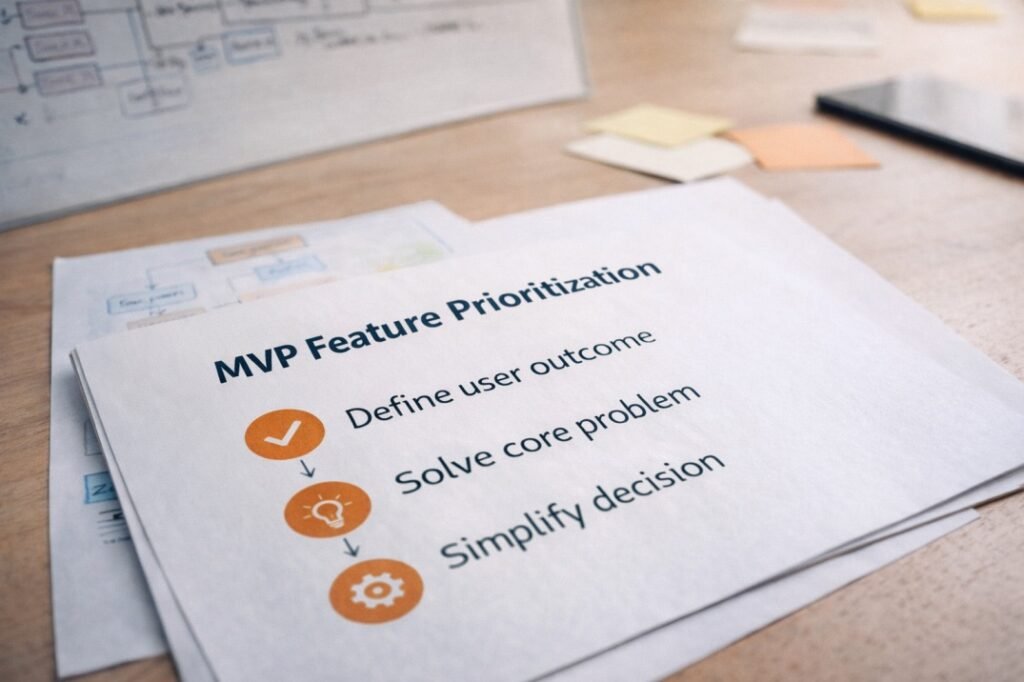
A Simple MVP Feature Prioritization Framework We Use Now
Today, every feature goes through this filter:
- What user result does this feature enable?
- Which core problem does it solve?
- Does it simplify or complicate the MVP?
- What will we learn by building it?
If we can’t answer these clearly, the feature waits.
Strong MVP feature prioritization isn’t about saying no to ideas.
It’s about saying yes to the right learning.
How Better MVP Feature Prioritization Improves Product-Market Fit
Once we focused on outcomes instead of features:
- Feedback became clearer
- MVP development became faster
- Product decisions felt lighter
- Signals of product-market fit improved
The product didn’t grow bigger.
It grew sharper.
Good MVP feature prioritization didn’t just improve the product — it improved how we thought as founders
Final Thought: Build for Progress, Not Praise
It’s tempting to build features that look impressive in demos.
But real progress comes from building what actually works.
A startup MVP is not about showcasing effort. It’s about reducing uncertainty. Once we stopped chasing feature requests and focused on results, clarity followed.
And clarity changed everything.
A Note for Founders
If you’re constantly adding features but still unsure about adoption, growth, or direction, the issue might not be speed or skill.
It might be MVP feature prioritization.
If you want to talk through your MVP, product decisions, or next step, you can book a Founder Clarity Call. One honest conversation can save months of unnecessary building.
Frequently Asked Questions (FAQs)
What is MVP feature prioritization?
MVP feature prioritization is the process of deciding which features to build first based on learning value and user outcomes, not assumptions or requests.
What is the biggest MVP development mistake founders make?
Treating feature requests as requirements instead of understanding the real problem behind them.
How do user interviews help with MVP feature prioritization?
User interviews reveal intent, context, and desired outcomes — which helps founders prioritize features that actually matter.