When I first started building products, I thought I clearly understood the MVP meaning.
A smaller product.
Fewer features.
Launch fast.
That’s what everyone around me seemed to agree on.
But that understanding turned out to be incomplete — and expensive. Over time, I realized that most founders don’t struggle because they can’t build an MVP. They struggle because they misunderstand what an MVP is actually supposed to do.
This article is about what an MVP is not, why this confusion exists, and how thinking clearly about MVP meaning can save you months of wrong execution.
The Real MVP Meaning Most Founders Miss
An MVP is not a milestone.
It’s not a badge of progress.
And it’s definitely not a smaller version of your final product.
The real MVP meaning is simple:
An MVP is a learning tool.
Its job is to help you validate assumptions, reduce uncertainty, and make better decisions — not to impress users or look complete.
Missing this is one of the most common MVP mistakes founders make.
An MVP Is NOT a Smaller Version of the Final Product
This is where many startup MVPs go wrong.
Founders try to predict the final product too early. They design flows, features, and experiences as if they already know what success looks like.
But at the MVP stage, you don’t.
When you treat an MVP as a reduced final product:
- You lock assumptions too early
- You resist feedback that challenges your thinking
- You overbuild before learning
A good MVP should feel temporary.
If you’re afraid to change it, it’s probably too heavy.
An MVP Is NOT About Features
Another common misunderstanding of MVP meaning is feature obsession.
Founders ask:
- “Which features should we include in the MVP?”
- “Is this feature MVP-ready?”
These are the wrong questions.
The better question is:
“What is the single assumption we need to test right now?”
A startup MVP exists to test assumptions — not to showcase functionality. Focusing on features too early leads to noise instead of clarity.
An MVP Is NOT Meant to Scale
This one is uncomfortable, but important.
An MVP is not built to scale.
It’s built to:
- Break quickly
- Teach you something fast
- Expose what actually matters
Trying to scale an MVP before you understand the problem clearly is one of the most damaging startup MVP mistakes. It usually shows up later as technical debt, confused users, and slow progress.
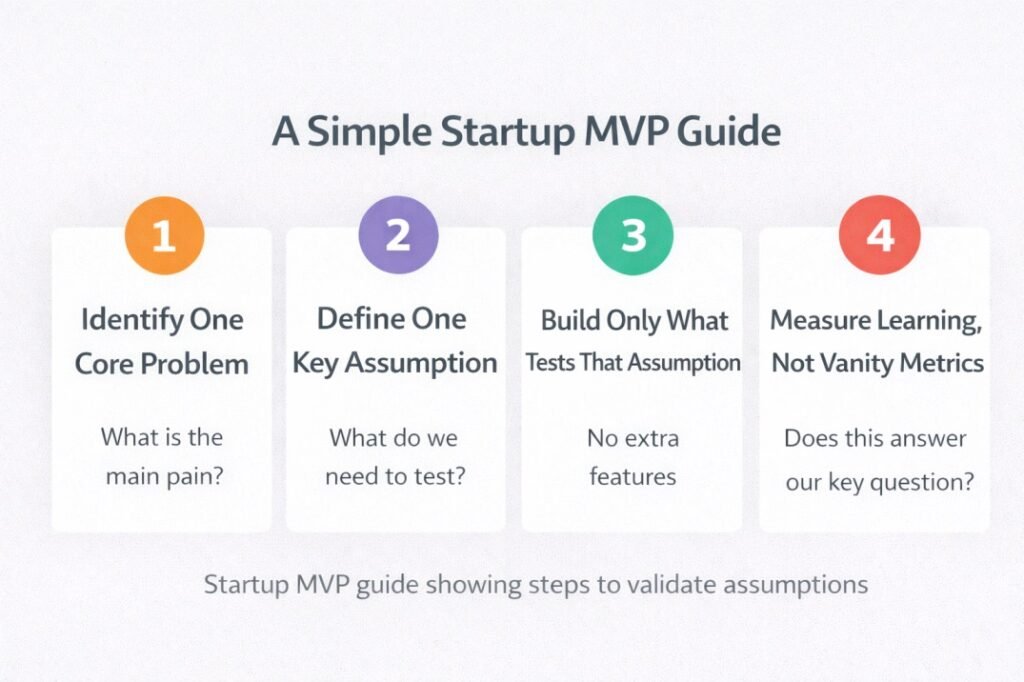
A Practical Startup MVP Guide: What to Focus On Instead
Once I understood the real MVP meaning, our approach changed.
Instead of asking what to build, we focused on what to learn.
Here’s the simple framework we now follow:
- Identify one core problem
- Define one key assumption
- Build only what tests that assumption
- Measure learning, not vanity metrics
This reduced confusion and made MVP development far more effective.
Why Most Founders Still Get MVP Meaning Wrong
Because building feels productive.
Thinking feels slow.
But MVPs don’t reward speed alone — they reward clarity. Founders who struggle usually aren’t lazy. They’re just building before thinking clearly enough.
Understanding MVP meaning early doesn’t slow you down.
It prevents you from running fast in the wrong direction.
Also Read: The MVP Trap: Why Building More Features Slowed Us Down
An MVP Is About Direction, Not Speed
An MVP is not proof that you’re moving forward.
It’s proof that you’re learning.
If your MVP doesn’t give you clearer direction than before, then it’s not doing its job — no matter how fast you shipped it.
Getting the MVP meaning right early can save you months of confusion later.
A Note for Founders
If you’ve built an MVP but still feel unsure about direction, scope, or next steps, the problem might not be execution.
It might be clarity.
If you want to talk through your MVP assumptions or product direction, you can book a Founder Clarity Call. One clear conversation can prevent very expensive mistakes.
What is the real MVP meaning in startups?
MVP stands for Minimum Viable Product, but its real purpose is to validate assumptions and learn quickly — not to impress users.
What is the biggest MVP mistake founders make?
Treating the MVP as a smaller final product instead of a learning tool.
Should an MVP include many features?
No. An MVP should include only what’s necessary to test one core assumption.
Is an MVP supposed to scale?
No. MVPs are built for learning and clarity, not scale.
When should I move beyond an MVP?
Once you’ve validated the problem, confirmed value, and gained enough clarity to make confident product decisions.