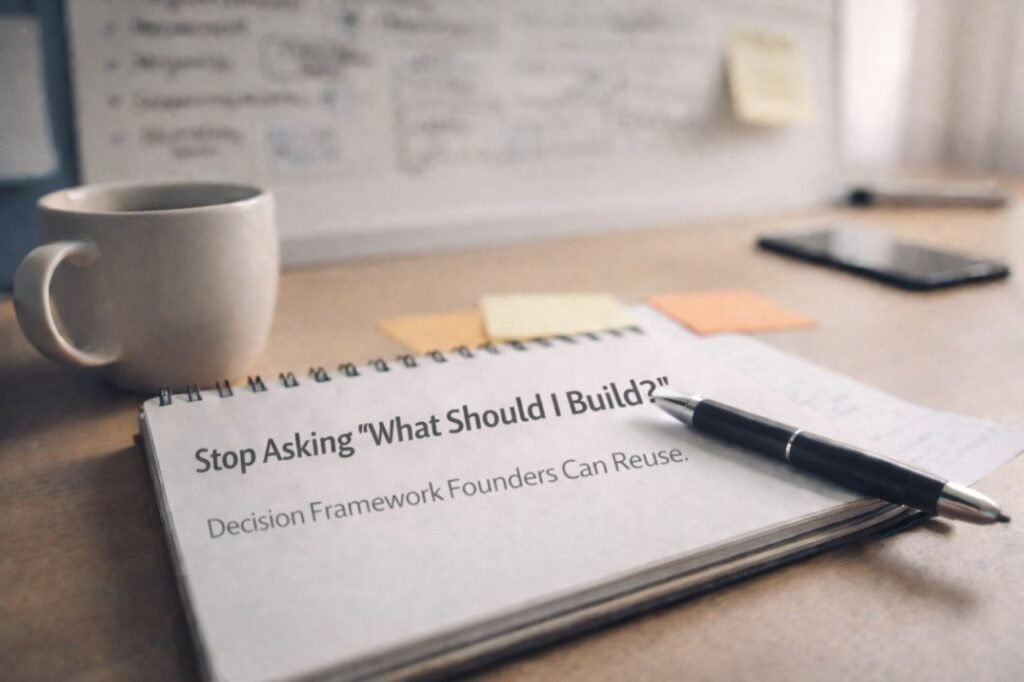
At some point, almost every founder asks the same question: “What should I build?”
I’ve asked it myself — more times than I’d like to admit.
It usually comes up when:
- You have too many ideas
- Feedback is pulling you in different directions
- Progress feels slow despite effort
The question sounds logical.
It feels productive.
But over time, I realized something uncomfortable:
“What should I build?” is often the wrong question.
Why “What Should I Build?” Keeps Founders Stuck
The problem with asking what to build is that it jumps straight to execution.
It skips clarity.
When founders ask “What should I build?” they’re usually unclear about:
- The real problem
- The user they’re solving for
- The outcome they want
So the question creates pressure instead of direction.
You start collecting opinions.
You listen to louder voices.
You chase features that sound right.
And slowly, confusion grows.
The Real Question Founders Should Ask Instead
Here’s the question that changed how I make decisions:
“What decision am I trying to make right now?”
This question forces clarity.
Because building is never the goal.
Decisions are.
When you frame the problem as a decision, everything becomes sharper:
- What information you actually need
- What assumptions must be tested
- What not to build yet
How Asking the Wrong Question Leads to MVP Mistakes
Most MVP confusion starts here.
Founders ask:
- “What should we build first?”
- “Which feature should go into the MVP?”
Instead, they should ask:
- “What uncertainty are we trying to reduce?”
- “What would we do differently if this assumption is false?”
When you skip this step, you end up building to feel busy — not to learn.
That’s how MVPs become bloated and directionless.
A Simple Decision Framework I Reuse Every Time
Whenever I catch myself asking “What should I build?”, I pause and run through this framework:
1. What decision is blocked right now?
Growth? Positioning? User problem? Pricing?
2. What assumption is behind that decision?
Something you believe — but haven’t validated.
3. What is the smallest action that tests it?
Not a full feature. Just enough to learn.
4. What will I do differently if I’m wrong?
If the answer is “nothing,” don’t build yet.
This framework has saved me from months of unnecessary execution.
Why This Question Changes Everything
When you stop asking what to build and start asking what to decide:
- MVP scope becomes clearer
- Feature prioritization becomes easier
- Feedback becomes more meaningful
- Execution becomes lighter
You stop reacting.
You start choosing.
That’s the shift most founders need.
The Hidden Comfort of Building (And Why It’s Risky)
Building feels safe.
It feels like progress.
It feels measurable.
But building without clarity is just motion.
Asking “What should I build?” often protects us from making hard decisions — because decisions force commitment.
And commitment is uncomfortable.
Builders Don’t Win. Deciders Do.
Startups don’t fail because founders can’t build.
They fail because founders delay decisions.
So the next time you feel stuck, overwhelmed, or unsure — don’t ask:
“What should I build?”
Ask:
“What decision am I avoiding?”
The answer will usually tell you exactly what to do next.
A Note for Founders
If you’re stuck between ideas, features, or next steps, the problem might not be execution.
It might be decision clarity.
If you want to talk through the decision behind what you’re building, you can book a Founder Clarity Call. One focused conversation often unlocks direction faster than weeks of guessing.
Frequently Asked Questions (FAQs)
Why is “What should I build?” the wrong question for founders?
Because it skips clarity and jumps straight to execution. Building should serve a decision, not replace it.
What should founders ask instead of “What should I build?”
They should ask what decision they’re trying to make and what assumption needs validation.
How does this help with MVP development?
It keeps MVPs focused on learning, not feature accumulation.
Can this framework be reused at later stages?
Yes. This decision framework works for MVPs, growth experiments, and scaling decisions.
How do I know if I’m building the wrong thing?
If you can’t clearly explain what decision the build helps you make, you’re likely building too early.