When we started building our MVP, I genuinely believed we were doing things right.
We were shipping fast.
We were adding features based on feedback.
We were constantly “improving” the product.
From the outside, it looked like progress.
From the inside, something felt off.
Despite all the effort, growth was slow. User conversations were confusing. Every new feature created more questions instead of answers. Our MVP was alive — but clarity was missing.
That’s when I realized we had fallen into what I now call the MVP trap.
Table of Contents
What Most Founders Get Wrong About MVPs
In theory, everyone knows what an MVP is.
In practice, most founders misunderstand it.
A Minimum Viable Product is often treated as:
- A smaller version of the final product
- A feature-light but “complete” solution
- Something to impress early users
That’s where the mistake begins.
An MVP is not built to impress.
It’s built to learn.
The real goal of MVP development is not adoption or growth — it’s clarity. Clarity about the problem, the user, and what actually matters.
When that purpose gets lost, features quietly become distractions.
Where We Went Wrong
Looking back, our mistakes were subtle — and that’s why they were dangerous.
We added features because:
- A user casually mentioned them
- Competitors had something similar
- It felt like the “next logical step”

But we weren’t asking the right question.
We weren’t asking:
“What are we trying to learn with this feature?”
Instead, we were reacting.
We confused:
- Feedback with direction
- Activity with progress
- Speed with momentum
As a founder, it felt productive.
As a product, it became noisy.
This is one of the most common startup MVP mistakes, and it usually shows up only after time has already been lost.
The Hidden Cost of Building More Features
More features didn’t just slow development — they slowed thinking.
Here’s what actually happened:
- Feedback became inconsistent
- Users focused on different things
- The team debated instead of deciding
- Prioritization became emotional
Every additional feature diluted the core signal we needed.
The MVP stopped being a learning tool and slowly turned into a guessing machine.
The hardest realization was this:
Every extra feature delayed the one insight that could have moved us forward.
What Actually Helped Us Move Forward
Progress didn’t come from building more.
It came from deciding less.
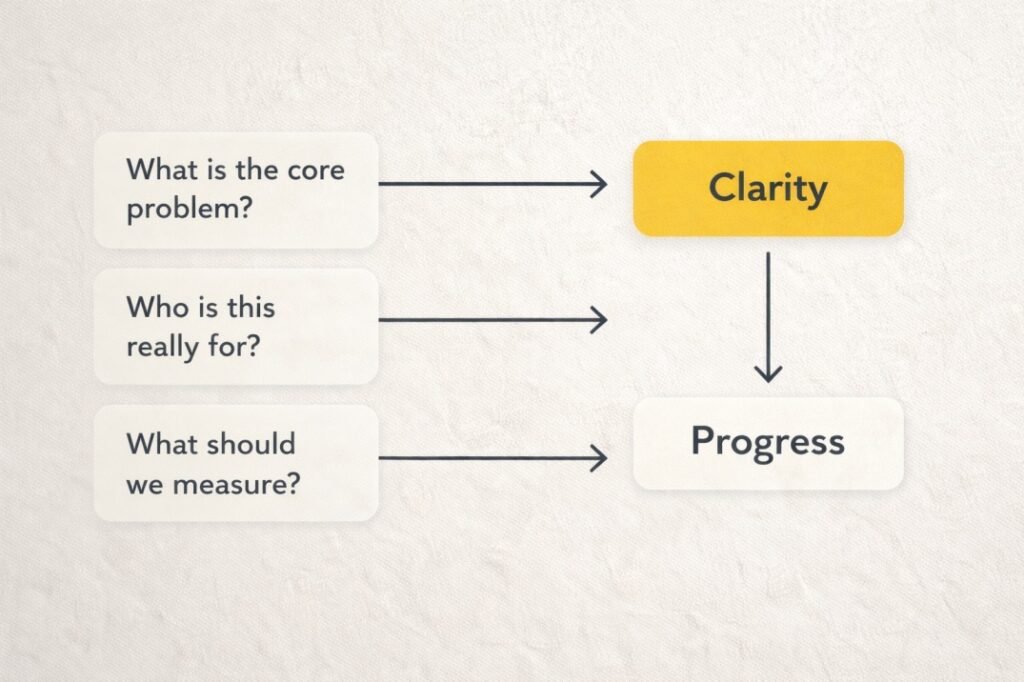
We simplified everything around one goal: product clarity.
We asked ourselves four questions:
- What is the single core problem we are solving?
- Who is this MVP really for?
- What does success look like at this stage?
- What decision should this MVP help us make?
Once we aligned on these, feature prioritization became easier.
If a feature didn’t help answer a question, it didn’t belong in the MVP.
That shift alone changed how we approached early-stage startup growth.
A Simple Guide to Avoid the MVP Trap
If you’re building or refining an MVP, these rules can save months:
- If a feature doesn’t help you learn, don’t build it
- If feedback feels confusing, simplify the product
- If you can’t explain your MVP in one clear sentence, pause
- If growth is slow, revisit clarity before adding code
MVP development is less about execution and more about founder decision-making.
Clarity Beats Speed
Speed matters. Execution matters. Shipping matters.
But none of them matter if you’re building the wrong thing.
Once we stopped chasing features and started chasing clarity, decisions became lighter. Learning became faster. Growth finally made sense.
The MVP didn’t become smaller.
It became sharper.
A Quick Note for Founders
If you’re stuck adding features but still feeling unsure about your product or direction, the issue might not be effort or execution — it might be clarity.
You can book a Founder Clarity Call if you want to talk through your MVP, product decisions, or next step before things get expensive.